Trends in e-learning: AI, personalization, and interactive video
Author
Monique van der Wal

Date
December 15, 2025
Reading time
4 min.
At the end of the last century, the term ‘e-learning’ was first used by the American Elliott Masie. However, distance learning has existed much longer, dating back to the nineteenth century.
The history of e-learning may be a bit shorter, but that does not mean that nothing has happened in the more than 25 years since. On the contrary, developments have progressed rapidly, with studying through e-learning having been promoted from something for nerds to the standard for many educational institutions and companies. In this blog, we will discuss current trends.
At the end of the last century, the term ‘e-learning’ was first used by the American Elliott Masie. However, distance learning has existed for much longer, as it was already done in the nineteenth century.
The history of e-learning may be a bit shorter, but that does not mean that nothing has happened in the over 25 years. On the contrary, the developments have gone incredibly fast, with studying through e-learning being elevated from something for nerds to the standard for many educational institutions and companies. In this blog, we will discuss current trends.

AI in e-learning (and personal learning)
Artificial intelligence, better known as AI, is being used more and more, and we can say with certainty that this will only increase in the coming years. AI can be employed in various ways by developers of e-learning, for example in the field of personal learning. These so-called adaptive learning systems ensure that e-learning increasingly aligns with individual learners rather than just a broad audience.
AI can provide automatic feedback and assessment, not only for multiple-choice questions but also for open-ended questions. Through tools like ChatGPT, it is also possible to automatically generate content or rewrite existing content.
Personalization in e-learning
Above, we have already discussed some things regarding the development of personalization in e-learning. There is an increasing demand for this, and the good news is that the possibilities in terms of offerings are only becoming more numerous.
In onboarding and study materials, improved personalization primarily manifests itself in the area of development. Every student starts from the same point, but some progress faster than others. One of the great advantages of e-learning is that students can study at their own pace. AI assists in this process, for example by offering extra material if a student answers knowledge questions incorrectly, but also in the area of gamification.
AI in e-learnings (and personal learning)
Artificial intelligence, better known as AI, is being used more and more, and we can confidently state that this will only increase in the coming years. AI can be implemented in various ways by developers of e-learnings, for example in the field of personal learning. These so-called adaptive learning systems ensure that e-learnings are increasingly tailored to individual learners, and not just to a broad audience.
AI can provide automatic feedback and assessment, not only for multiple-choice questions but also for open questions. Through tools like ChatGPT, it is also possible to automatically generate content or rewrite existing content.
Personalization in e-learnings
Above, we have already discussed some aspects of the development of personalization in e-learnings. There is an increasing demand for this, and the great thing is that the possibilities in terms of offerings are only becoming more numerous.
In onboarding and study materials, improved personalization especially emerges in terms of development. Every student starts from the same point, but some progress faster than others. One of the major advantages of e-learning is that students can study at their own pace. AI assists in this, for example by offering additional material if a student answers knowledge questions incorrectly, but also in the area of gamification.


Gamification with AI
Gamification gives an online training a more than decent twist. The training not only becomes more fun but also more effective. Gamification can be applied in multiple ways, for example through a quiz, a points system, or a competition element.
With gamification using AI, one can think of a learning game that becomes harder as the student improves. This is again a nice example of personalizing the material. Every participant in the e-learning starts at the same level in the learning game, but the fast learner is challenged more, while the learner who finds it harder receives extra help. This keeps the e-learning challenging and interesting for everyone.
Gamification with AI
Gamification gives an online training an more than pleasant twist. The training becomes not only more fun but also more effective. Gamification can be applied in multiple ways, for example through a quiz, a points system, or a competition element.
With gamification using AI, one can think of a learning game that becomes more difficult as the learner improves. This is again a nice example of personalizing the material. Every participant in the e-learning starts at the same level in the learning game, but the fast learner is challenged more, while the learner who finds it more difficult receives extra help. This way, the e-learning remains challenging and interesting for everyone.
Interactive video in e-learning
Do you sometimes think back with a stomachache to the bag full of books that you had to drag from classroom to classroom in high school? That time isn't completely over yet, but even in high schools, digital learning tools are being used more and more. In e-learnings, the balance between text and image is tipping towards the image.
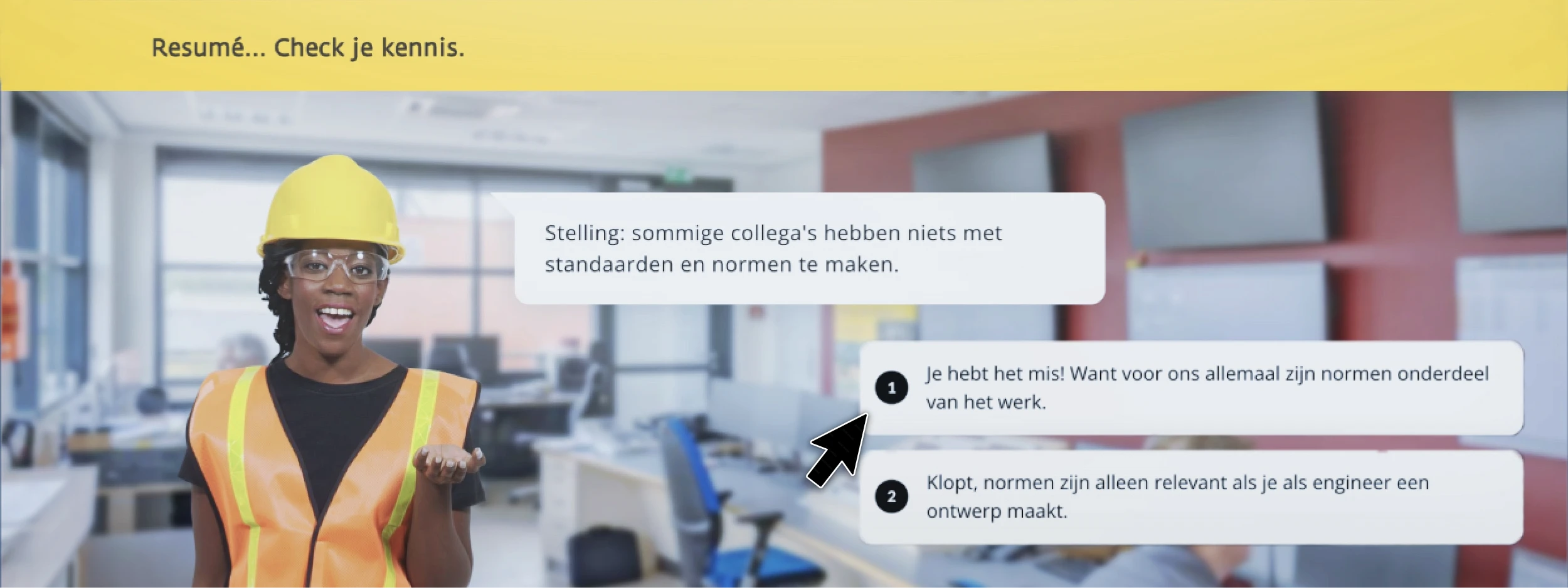
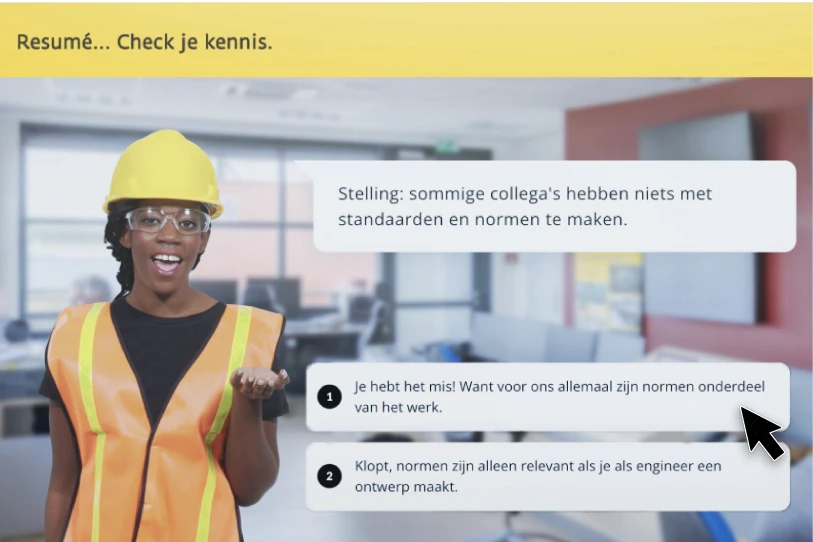
Images can be still (photo) or moving (video). In the latter category, interactive video is quickly gaining popularity. Interactive videos ensure that the viewer is not just passively watching, as if it were a series on Netflix, but actively participating. Here are some examples of interactive videos:
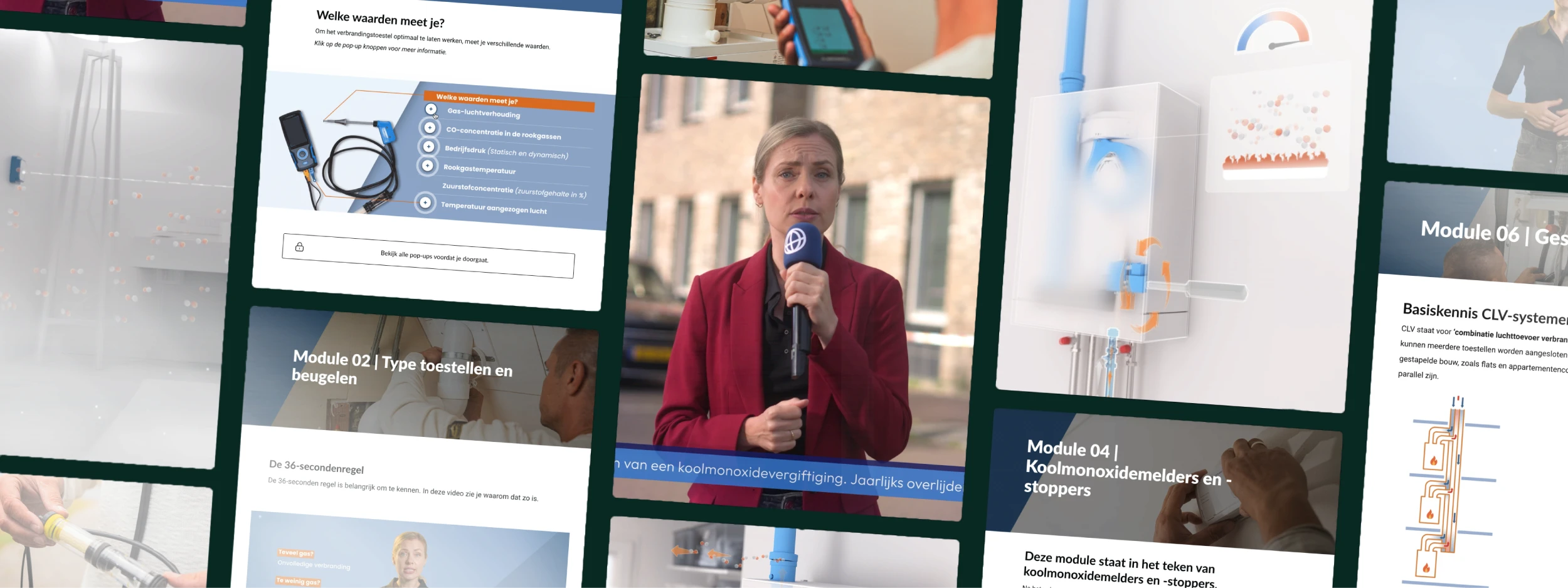
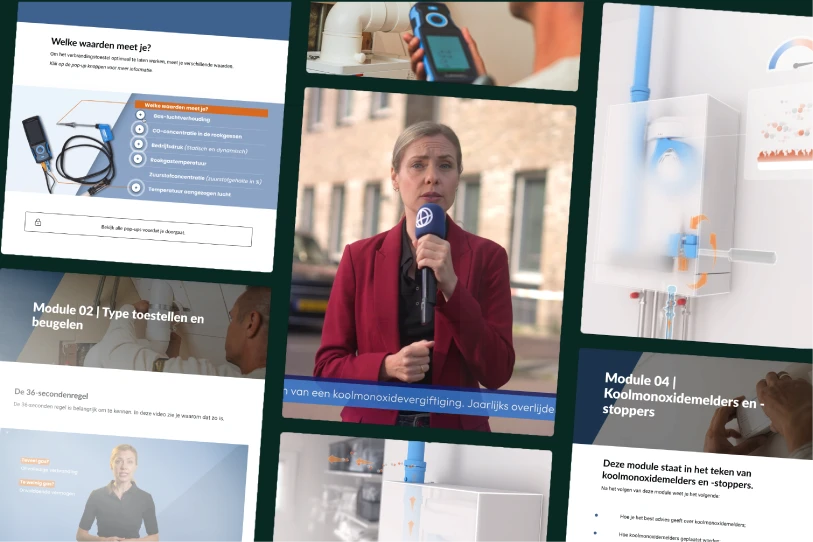
Knowledge checks during the video: during the explanation of a certain topic, the viewer is asked a specific question that must be answered immediately. With a correct answer, the video continues; with an incorrect answer, further explanation follows. A concrete example is the assembly of a boiler, where the viewer steps into the mind of the technician. This is called a simulation video.
Scenario-based learning: in a training on customer service, the viewer chooses what an employee says to an angry customer. Each choice leads to a different outcome or response. The student thus experiences in a realistic context what the consequences of their decisions are.
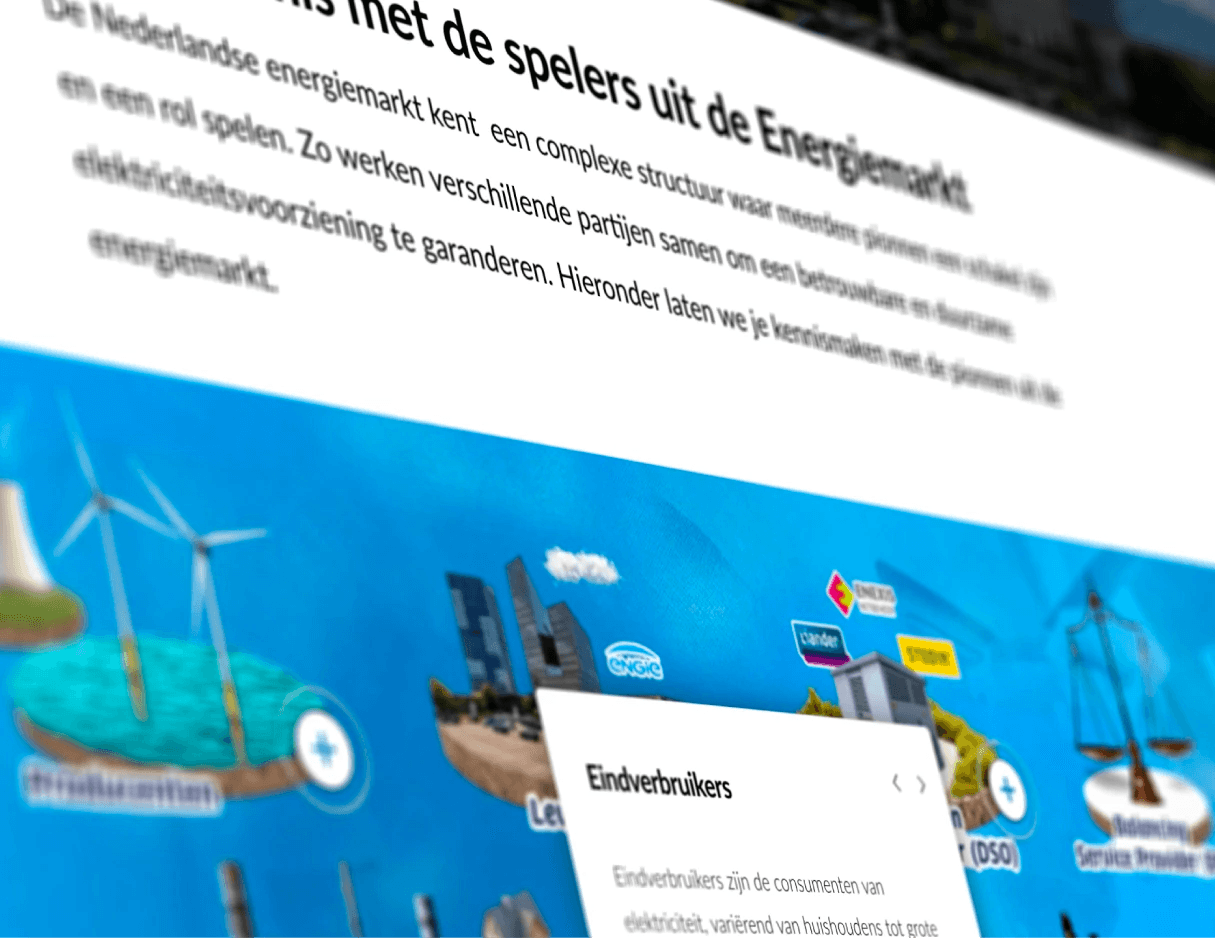
Clickable hotspots: clickable hotspots appear on the screen during the video. When the user clicks the button, an explanation about the respective function appears.
Interviews or discussions with choice moments: this can be applied, for example, in an onboarding process. Two colleagues share their perspectives on the company or a specific business process, and the viewer then chooses who they want to continue talking with.
An interactive video fosters active involvement and thus increases retention. The simulations make the application of knowledge more realistic, and the immediate feedback enhances learning. An interactive video comes very close to practical training, and no matter how important theory is, it almost always comes down to applying knowledge in practice.
Interactive Video in E-Learning
Do you often think back with a stomachache to the bag full of books that you had to drag from classroom to classroom in high school? That time is not completely over yet, but digital learning tools are increasingly being used in high schools as well. In e-learnings, the balance between text and image is beginning to tip towards the image side.
Images can be static (photo) or dynamic (video). In the latter category, interactive video is quickly gaining popularity. Interactive videos ensure that the viewer does not just passively watch as if it were a series on Netflix, but actively participates. Here are some examples of interactive videos:
Knowledge checks during the video: during the explanation of a certain topic, the viewer receives a specific question that must be answered immediately. With a correct answer, the video continues; with an incorrect answer, there is further explanation. A concrete example is the assembly of a boiler, where the viewer steps into the mind of the technician. This is called a simulation video.
Scenario-based learning: in a training on customer service, the viewer chooses what an employee says to an angry customer. Each choice leads to a different outcome or reaction. The student thus experiences in a realistic context the consequences of their decisions.
Clickable hotspots: clickable hotspots appear on the screen in the video. When the user clicks the button, an explanation of the relevant function appears.
Interviews or discussions with decision points: this can be applied, for example, in onboarding. Two colleagues share their perspectives about the company or a specific business process, and the viewer then chooses who they want to continue talking with.
An interactive video fosters active engagement and thereby increases retention. The simulations make applying knowledge more realistic, and the immediate feedback promotes learning. An interactive video comes very close to a practical training session, and no matter how important theory is, it almost always comes down to applying knowledge in practice.
Conclusion: these are the trends in e-learning
At the beginning of this blog, we jokingly wrote that e-learnings were only found interesting by nerds in the past. While that is certainly not entirely true, it is a fact that an e-learning in 2025 is much more than a digital textbook. Thanks to developments such as AI, the possibilities are becoming increasingly numerous.
AI is an important trend that allows e-learnings to be personalized. With that, we immediately have a second trend. E-learnings are taking on an increasingly personal character, even if they are developed for a broader audience.
Finally, interactive videos are on the rise. Interactive videos challenge the student to engage actively and not just passively receive the material. Work begins immediately, which increases the effectiveness of the e-learning.
Conclusion: these are the trends in e-learning
At the beginning of this blog, we jokingly wrote that e-learnings were only interesting to nerds. While this is not completely true, it is a fact that an e-learning in 2025 is much more than a digital textbook. Thanks to developments like AI, the possibilities are becoming increasingly numerous.
AI is an important trend, allowing e-learnings to be personalized. That gives us a second trend right away. E-learnings are becoming increasingly personal, even when developed for a broader audience.
Finally, interactive videos are on the rise. Interactive videos challenge the student to actively engage and not just passively receive the material. Working on it starts right away, which increases the effectiveness of the e-learning.
About the author
Monique studied illustration and then completed a master's in fine arts. At Indall, she works as a creative, specializing in graphic design. She develops concepts and infographics, among other things, to make technical content practically understandable.
Monique van der Wal
creative

About the author
Monique studied illustration and then completed a master's in fine arts. At Indall, she works as a creative, specializing in graphic design. She develops concepts and infographics, among other things, to make technical content practically understandable.
Monique van der Wal
founder
About the author
Monique studied illustration and then completed a master's in fine arts. At Indall, she works as a creative, specializing in graphic design. She develops concepts and infographics, among other things, to make technical content practically understandable.
Monique van der Wal
creative